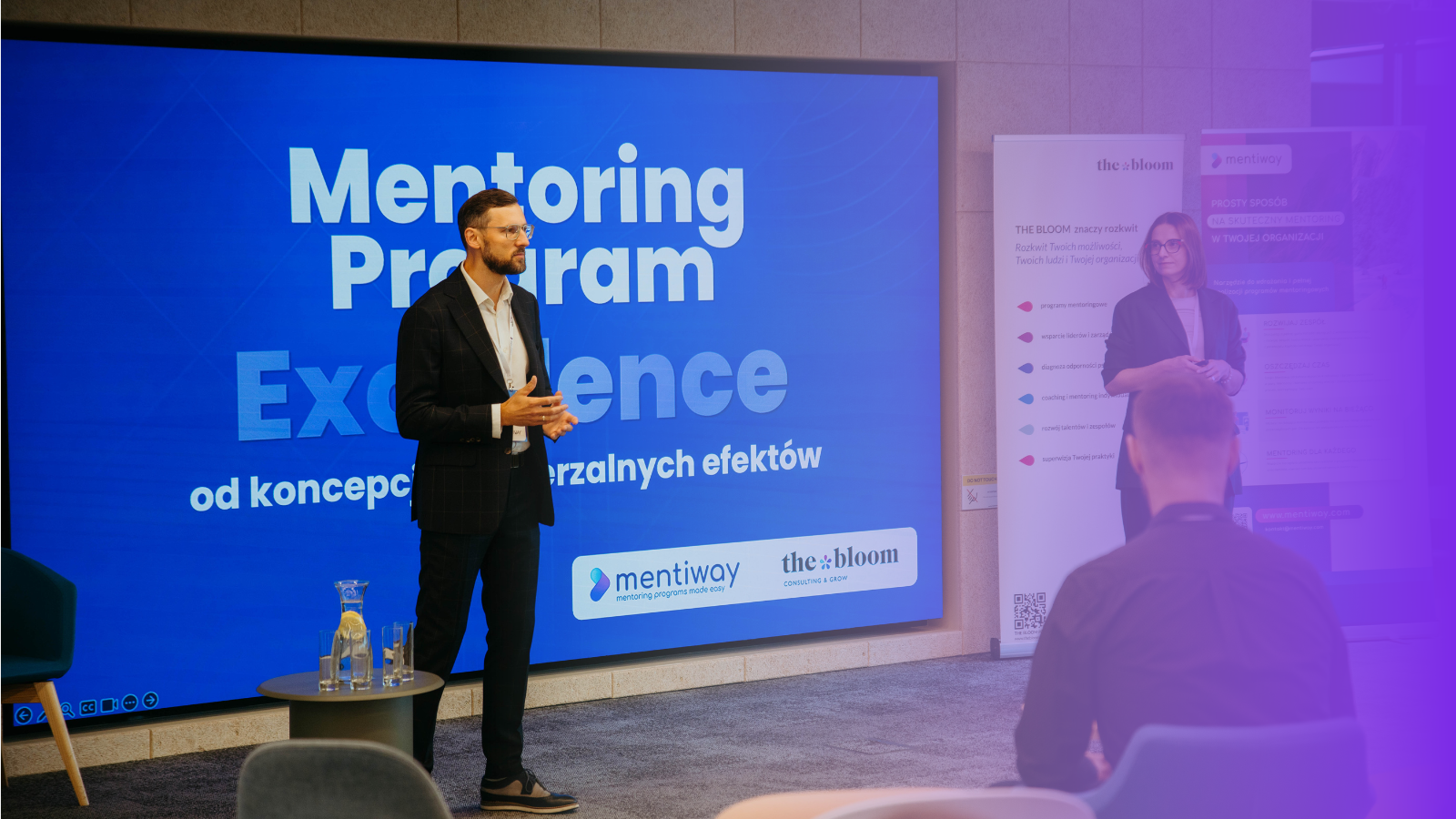



Mentoring Program Excellence: Key insights on designing and developing mentoring programs
All articles published on the Mentiway blog are written by human mentoring consultants. AI systems are used solely for translation and image generation.
Can mentoring be a strategic investment, not just an employee benefit? How do you design a program that will keep participants engaged beyond the first edition? What should you do when the organization grows, changes strategy or starts needing new competencies? And where in all of this is there room for ethics, reverse mentoring and artificial intelligence?
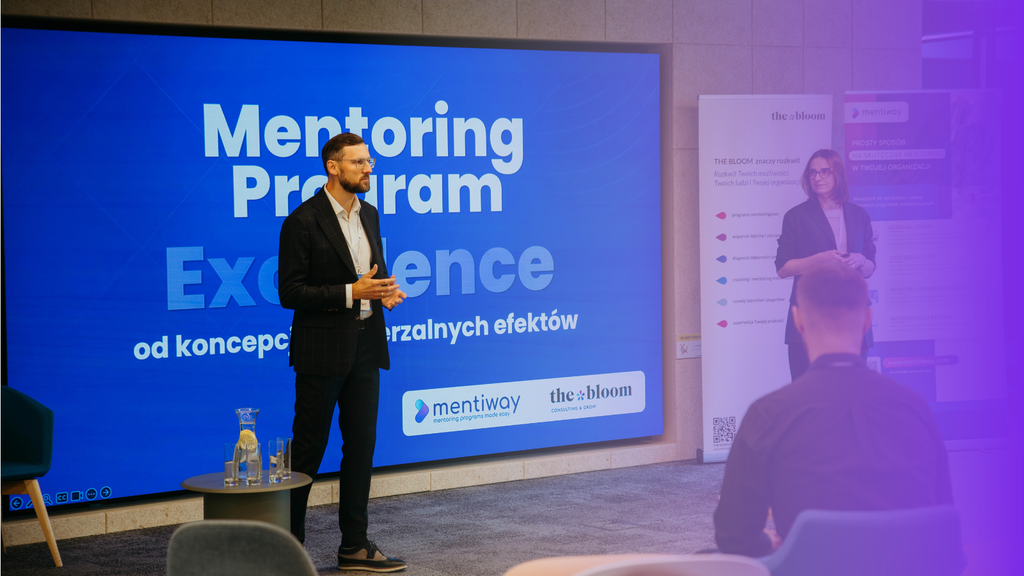
This is only part of the set of questions that came up during Mentoring Program Excellence – an event dedicated to designing, running and developing mature mentoring programs. Presentations and discussions brought together several perspectives: people responsible for mentoring programs in large organizations, mentors, mentees and experts dealing with standards, reverse mentoring and AI.
Topics varied, but a clear common denominator emerged across the presentations: a mature mentoring program does not start with matching. It starts with answering the question of why the organization actually needs mentoring.
In brief
- Start with a business objective: mentoring should solve a specific problem, not be an end in itself.
- Mentoring is a process: it requires preparing mentors, trust, measurement and continuous improvement after each edition.
- Scaling requires process, data and technology; tools facilitate pair matching, process monitoring and reporting.
- The Mentiway platform makes recruitment, matching, session monitoring and reporting easier, centralizes and automates mentoring processes, which helps scale programs without manual work from organizers. Contact Mentiway
Mentoring should not be an end in itself
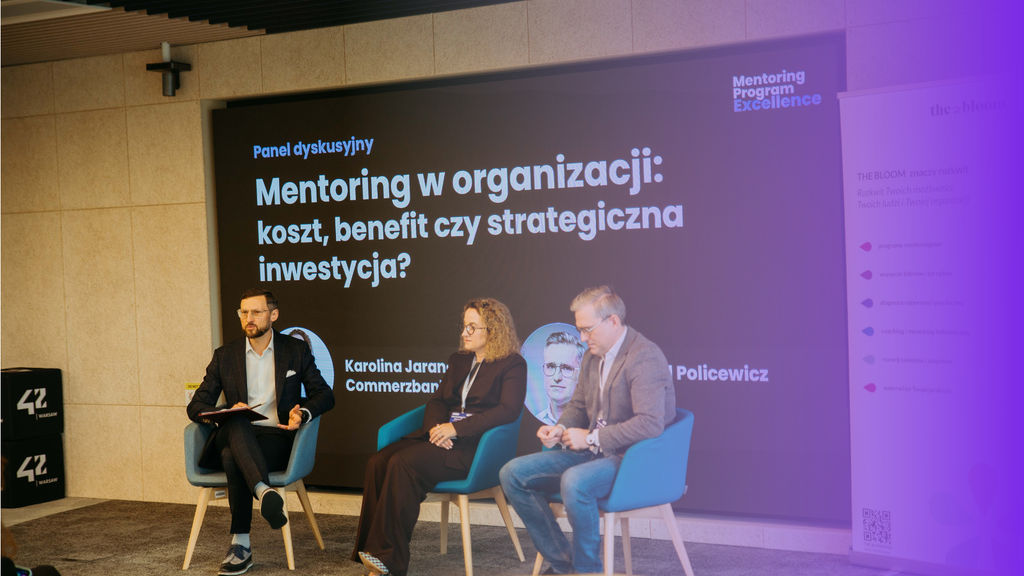
At the panel „Mentoring in the organization – cost, benefit or strategic investment?” a question arose that, at some point, every organization planning a larger program must ask itself: how to justify its existence to the board, a sponsor, or those responsible for the budget?
The answer is not simply to demonstrate that participants like mentoring. As Konrad Policewicz, Head of HR at mBank Group, put it: „Not a business case for mentoring itself, but a business case for successes”. That is actually one of the most important lessons of the whole event.
If an organization needs a larger pool of future leaders, the problem is not the absence of a mentoring program. The problem is the lack of a sufficient number of people prepared for new roles. A company may want to reduce the risk of knowledge loss, but the starting point is that risk itself, not the need to “launch mentoring”. If the organization is undergoing digital transformation, the program can support the development of the competencies needed in that process. After all the goal may be to increase the representation of women in leadership positions – in that case, mentoring can be one of the elements of broader action toward that goal.
In this view, mentoring becomes a tool for achieving a specific goal, not a separate HR initiative. This also means that its objectives, participants, mentor profile, matching method, and way of measuring outcomes should stem from the organization’s needs.
A mentoring program should evolve together with the organization
This idea resonated particularly strongly during a presentation devoted to designing a program in a large organization. Ania Ostaszewska from Santander Consumer Bank presented a program that has been developed over successive editions. One of its foundations is the program’s alignment with what is currently happening in the organization.
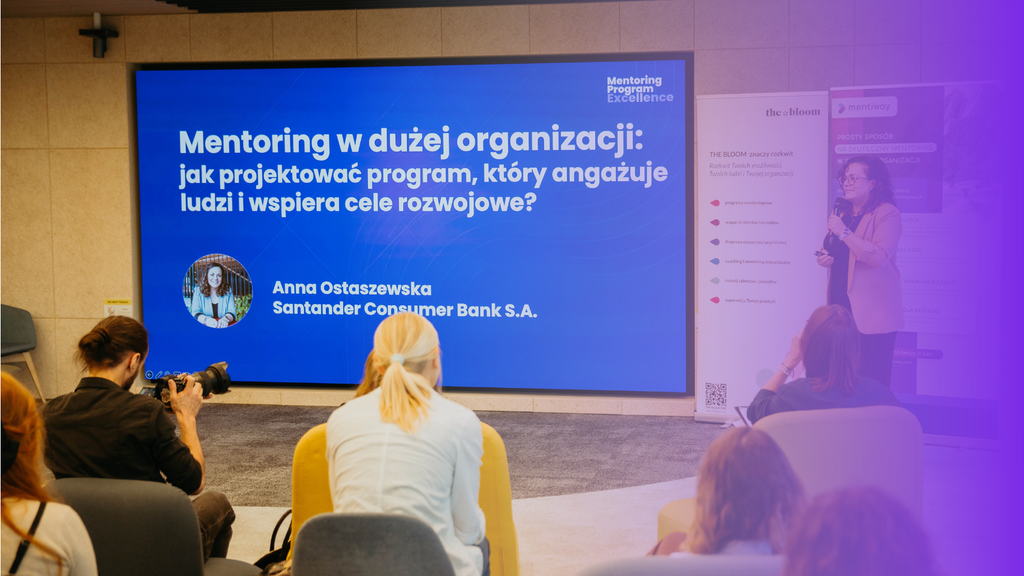
A good example was digitization. As the importance of that area grew within the organization, the mentor pool was expanded to include people with skills related to digitization. Interestingly, about one third of the goals that mentees worked on concerned that very area.
This highlights an important point: a mentoring program should not be a frozen project that looks the same for five consecutive years. The organization changes. New technologies, new roles, new competency needs and new business challenges emerge. Mentoring may change along with them.
Therefore, after each edition it is worth not only checking whether participants were satisfied, but also asking yourself: Does the program still meet what the organization needs today?
Good mentoring is a process, not a one-off event
The first presentation at the event began with the bamboo metaphor: for a long time its growth is not visible; the foundation forms underground; eventually, however, growth becomes very dynamic and clearly visible.
This metaphor was used to show that development cannot always be observed immediately. The fact that the effect is not visible today does not mean that nothing is happening. That is precisely why mentoring should be treated as a process, not a single event or a series of meetings.
This approach was also present in other presentations. At ING Bank Śląski, mentoring has been in place for about 10 years, but its form has changed along with the organization’s needs. After analyzing earlier experiences, the program was redesigned, among other things, in terms of accessibility, communication, matching and monitoring.
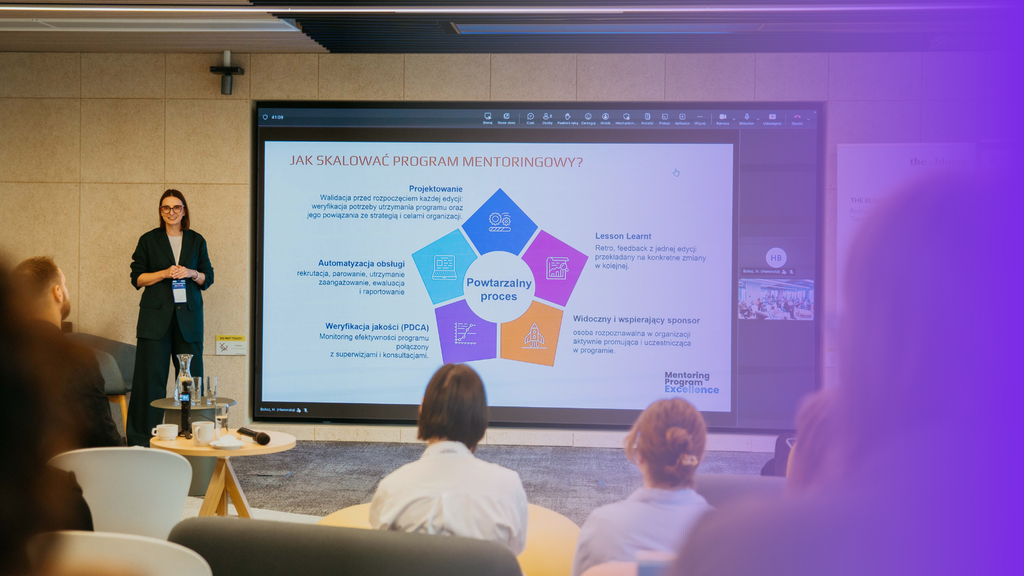
In the two analyzed editions almost 700 sessions and around 930 hours of individual support were delivered, and mentees achieved nearly 93%. However, it’s not only about the numbers. The most important lesson from this case study is: the program can grow if the organization is able to draw conclusions from successive editions and change what wasn’t working.
After each edition it is therefore worth doing more than just sending a satisfaction survey. It is worth conducting a program retrospective: what worked, what didn’t, and what should be changed before the next edition.
Scaling mentoring requires process, data and technology
When a program includes a dozen or so people, many things can be done manually. With several hundred participants the question of scaling arises. ING demonstrated this very concretely: in an organization of around 10,000 people, manual pairing limited the program’s capabilities. Monitoring progress in real time, evaluating effectiveness, and checking how mentors cope with their role were also problems.
This is one of the moments when technology supports organizers in areas such as:
- participant recruitment,
- matching,
- communication,
- monitoring activity,
- data collection,
- reporting,
- organizing the next stages of the program.
At the same time, technology does not solve design problems for the organizer. If a program does not have a clearly defined goal, simply automating matching will not create it.
First a good process. Then technology that helps scale it.
Matching is more than connecting two people
The topic of pairing arose several times during the event and from various perspectives.
In the panel “Mentoring from the inside – one program, several perspectives” they showed what matching looks like in a large organization of over 13,000 employees. Simply matching mentors’ competencies to mentees’ needs was not sufficient. It was also necessary to take into account the organizational structure, level of responsibility, differences between headquarters and the network, and the specifics of particular business areas.
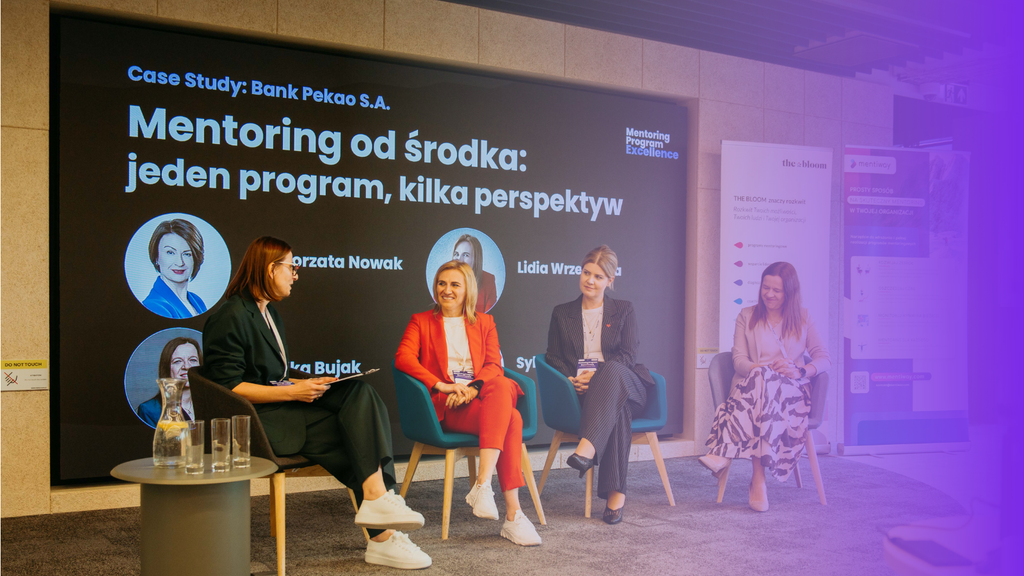
This shows that matching is both an analytical and a relational process. In one of the models presented, mentees were given several mentor options and could first meet them during initial meetings, and only afterwards decide whom they wanted to work with. It’s an interesting shift in perspective.
Good matching doesn’t have to mean finding one “ideal” pair in a spreadsheet. It can mean creating the conditions in which an appropriate relationship has a chance to develop.
Professional experience alone is not enough to be a good mentor
Another recurring thread of the event concerned preparing participants.
In the panel on the program for women at PKO Bank Polski, the importance of workshops held before the start of the mentoring relationship was emphasized. Participants and mentors learned not only the definition and structure of mentoring, but also the scope of responsibilities of both parties, contracting, working tools, active listening, communication and working with goals.
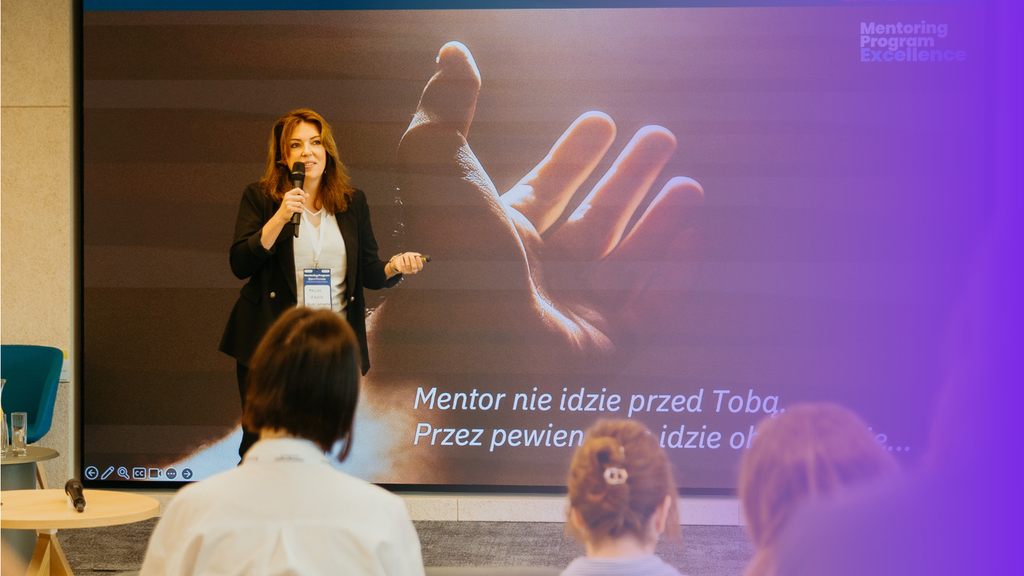
This is important because being a good expert does not automatically mean being a good mentor. Mentoring requires different skills: asking questions, listening, helping with reflection, working with goals, and also awareness of one’s role and its limits. Therefore, the professionalization of the program starts not with matching itself, but with preparing the people who will create mentoring relationships.
Trust and safety are not an add-on to the program
If mentoring is to address real professional challenges, the mentee must have the opportunity to tell the mentor about what is not working. And that requires trust.
In the panel dedicated to the program for women, attention was drawn to the importance of communication, a sense of safety and openness in the mentoring pair. Such a relationship cannot be built in a single training. It is a process that develops with subsequent meetings.
The topic of safety resonated even more strongly during the presentation ‘From global standards to organizational practice’. Three situations were presented there that clearly illustrate why mentoring rules should be thought through before something difficult happens.
- What if a mentor accidentally passes on to a manager information they heard from the mentee?
- What if a very experienced mentor starts telling the mentee what decision they should make?
- And what if a mentoring conversation stops being about professional development and begins to touch on a serious personal crisis?
In each of these cases the question arises about the boundaries of the mentor’s role, the organization’s responsibility and the rules of confidentiality. Therefore the mere statement ‘conversations are confidential’ may not be sufficient.
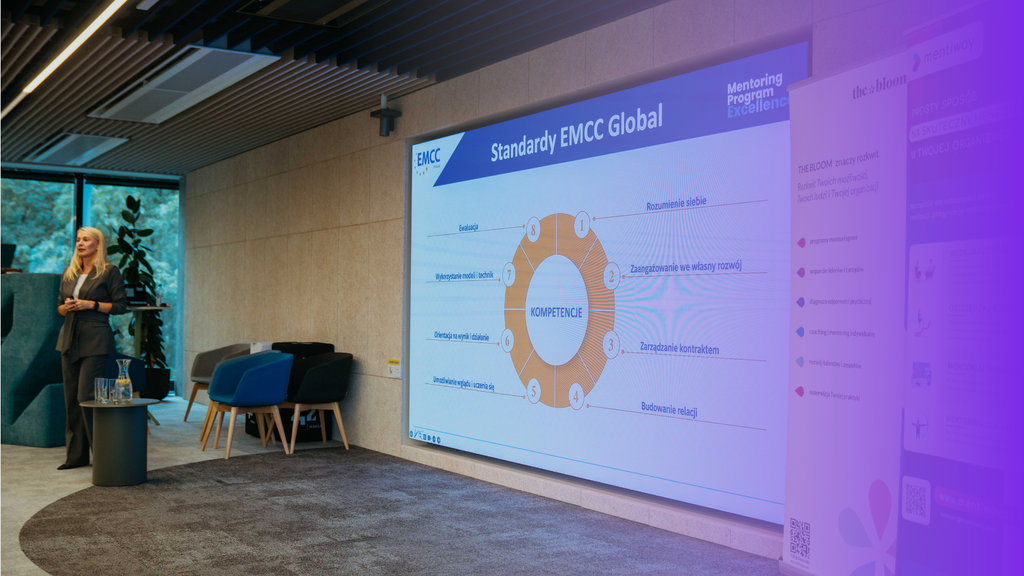
Participants should know, exactly what confidentiality means, what its limits are, what can be reported to the organization and what to do in situations that go beyond the mentor’s role. This is one of the elements that distinguish an informal developmental relationship from a professionally designed program.
The mentor should not make decisions for the mentee
The ethical thread leads to yet another important issue: the mentee’s autonomy. A mentor may have extensive experience, know the organization, hold a senior role and possess very strong authority. It is precisely then that the question becomes particularly important, whether they help the mentee make their own decision, or begin to make it for them.
A presentation on standards illustrated this problem with a simple example: a mentee comes with a professional dilemma, and the mentor says, “If I were you, I would accept that offer.” The mentee can, of course, make use of that perspective. But the aim of mentoring should not be to create a “junior copy” of the mentor.
A good mentor brings experience but does not take away the mentee’s agency.
This is especially important in programs where mentors are also senior leaders of the organization and have significantly greater formal or informal influence than the people they are supporting.
Mentoring can support organizational goals, but it’s worth measuring more than just satisfaction
During the event, the topic of measuring outcomes came up repeatedly. It was not just a question of: “Were the participants satisfied?”.
That is of course important. But if mentoring is to be part of the organization’s strategy, it’s also worth checking the following:
- whether mentees are achieving their set goals,
- what competencies they are developing,
- how active the pairs are,
- how many sessions are held,
- how the matching is assessed,
- whether participants want to return to the program,
- and above all: whether the program supports the goals for which it was launched.
In the case of the ING Bank program, measurement included, among other things, activity, goal achievement and satisfaction. Data from successive editions were then used to design subsequent iterations of the program.
This approach is also consistent with data from Mentiway reports. In a survey covering 613 questionnaires from 43 mentoring programs, 96.53% of respondents rated mentoring positively as a development method, and over 95% were satisfied with the pairing.
However, such data do not automatically mean that mentoring increased the company’s revenues, reduced turnover, or led to a specific number of promotions. This is precisely where caution is needed: not every positive organizational outcome can be attributed solely to mentoring. A good measurement should combine data about the program itself with KPIs resulting from its objective.

Reverse mentoring: not just ‘mentoring turned upside down’
One of the more prominent topics of the event was reverse mentoring, discussed by Prof. Małgorzata Sidor-Rządkowska. In the classic mentoring model we often assume that the mentor has greater professional experience and passes it on to the less experienced person. Reverse mentoring reverses that perspective.
A younger employee can support a more experienced leader in areas where they themselves have greater knowledge or different experience — for example regarding technology, new ways of working, or generational shifts. This is especially interesting in times of rapid technological change.
At the same time, the greatest barrier is not always a lack of knowledge or an appropriate program. It may be the mental readiness to learn from someone younger or lower in the organizational hierarchy. Therefore reverse mentoring requires even greater attention to the relationship, openness, and psychological safety. It’s not just about transferring knowledge. It’s about creating a relationship in which the person holding formal authority is genuinely willing to learn something from someone who has less of it.
And where does AI fit into all of this?
The final presentation, led by Mikołaj Sznajder, addressed the future of mentoring and the role of artificial intelligence.
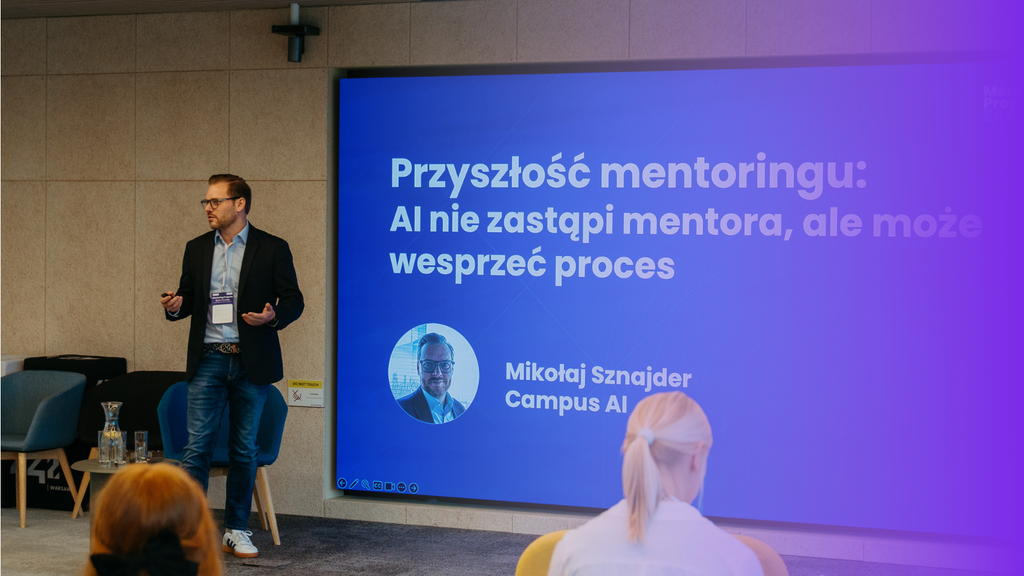
Here, too, an important boundary emerged. AI can increasingly help with gathering and organizing information, preparing for the conversation, asking questions, or looking at the problem from a different perspective. So it can be valuable support before a mentoring session and between sessions.
At the same time, a human still brings something that cannot be reduced to access to information: context; experience; the ability to read the nuances of a situation. To that should be added judgment – that is, an awareness of when it is worth questioning the mentee’s assumption, pausing the conversation, or looking at the problem from a completely different perspective.
Therefore the development of AI does not have to mean the end of mentoring. It can even make we will see even more clearly the value of a good relationship with another person.
What unites all these perspectives?
At first glance the eight presentations during Mentoring Program Excellence covered very different topics: development, strategy, scaling, case studies, standards, reverse mentoring, and AI.
When we look at them together, however, they form a fairly coherent picture: a mature mentoring program should combine several levels at once.
First: the organization’s goal – that is, the answer to the question of why the program actually exists.
Second: the participants’ experience – without engaged mentors and mentees, even the best-designed process will remain only a paper project.
Third: the quality of relationships – trust, safety, mentee autonomy and appropriate preparation for the role.
Fourth: structure and standards – from confidentiality rules, through matching, to participant preparation and ways of responding to difficult situations.
Fifth: data and continuous improvement – that is, checking what works, what doesn’t, and what should be changed in the next edition.
And finally: technology, which can help an organization organize and scale this process, but will not replace a good program design or the quality of relationships.
Mentoring Program Excellence: 10 key takeaways
If we were to draw a few insights from the event to bring into the organization, they would be:
- Start with the business objective, not with mentoring. First, answer the question of what problem you want to solve. Only then consider what role mentoring can play in that.
- The program should be linked to the organization’s strategy. If the company’s priorities change, the program may also need to change.
- Mentoring is a process. Development outcomes are not always immediately visible. Consistency, regularity and the ability to work across successive editions are important.
- It’s not enough to find people with significant experience and simply call them mentors. Mentors need preparation for their role.
- Matching is not a mere administrative task. Competencies are important, but so are the organizational context, the mentee’s goals and the chance to build a strong relationship.
- Safety and confidentiality must be designed, not just declared. Participants should know where the boundaries lie and what to do in a difficult situation.
- It’s worth measuring program outcomes at multiple levels. From activity and process quality, through achievement of development goals, to KPIs linked to the organizational objective.
- Scaling requires a repeatable process and data. What works for a few dozen people may not work for several hundred or several thousand participants.
- Reverse mentoring can be a response to real organizational challenges. Especially where there is a need to transfer technological, generational or cultural knowledge.
- AI can support mentoring but does not replace humans. Technology can help prepare for the conversation and structure reflection. The relationship, context, experience and judgment remain with the human.
What does this mean for an organization that is just planning a mentoring program?
The most important lesson from Mentoring Program Excellence doesn’t sound like: “mentoring works”.
It’s a bit more demanding: mentoring works differently in different organizations, because goals, participant groups, contexts and needs vary.
A program for future leaders will look different from mentoring that supports onboarding. A program for women preparing for leadership roles will have different assumptions than reverse mentoring, and a program developed in an organization with over ten thousand employees will require different processes than an initiative involving several dozen people.
Before launching a program, it’s worth answering a few basic questions:
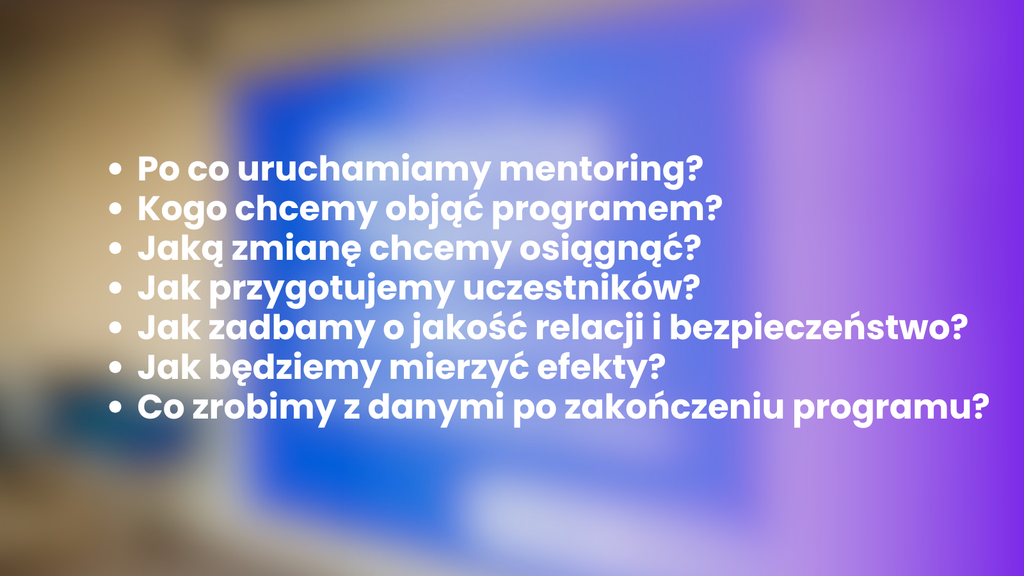
Only from those answers should the subsequent elements follow: program design, recruitment, matching, mentor preparation, communication, and tool selection.
How can Mentiway support an organization?
This is precisely where conference insights and Mentiway’s practice meet. We support organizations in designing and running mentoring programs: from participant recruitment, through matching, to process organization, monitoring and reporting.
This is especially important when the program begins to grow. With a larger number of participants, manually managing recruitment, matching pairs, communication or data collection can consume a significant portion of the organizers’ time. Technology will not replace the answer to the question: “what is this program for?” It can, however, help an organization translate a well-designed process into an operational program that can be monitored, developed and scaled.
At Mentiway we have experience with over 100 mentoring programs and thousands of participants. We describe some of the programs we run in our mentoring case studies, although due to confidentiality not all projects can be presented publicly.
FAQ: Mentoring Program Excellence and mentoring programs
What was Mentoring Program Excellence?
Mentoring Program Excellence is an event dedicated to the practice of designing, running and developing mentoring programmes. During the event, topics discussed included, among others, the strategic importance of mentoring, participant engagement, scaling programmes, measuring outcomes, ethics and standards, reverse mentoring and the use of AI in mentoring.
How to convince the board to launch a mentoring program?
It’s best to start not with mentoring itself but with a specific organisational objective. This might be, for example, developing future leaders, succession, retention, knowledge transfer or developing particular competencies. Next, it’s worth demonstrating how mentoring can support achieving that objective and how the programme’s results will be measured.
Can any experienced employee become a mentor?
Experience is an important element of the mentor role, but on its own it is not sufficient. A mentor also needs preparation for working with another person, familiarity with mentoring principles, skills in listening, asking questions and working with goals, as well as an awareness of the boundaries of their role.
How to measure the effectiveness of a mentoring program?
It’s worth measuring both the programme’s process and its outcomes. These can include, among others, pair activity, number of sessions, achievement of mentees’ goals, assessment of matching and participant experience, as well as KPIs directly related to the programme’s business objective.
Can AI replace a mentor?
AI can support session preparation, organising information, reflection and the exploration of additional perspectives. However, it does not replace the relationship, context, experience and human judgement, which are an essential part of mentoring.

Hi, my name is Thomas. I am the Co-Founder of Mentiway. We are happy to share our knowledge and support organisations on their way to success! 💪 If you are interested in how to efficiently and effectively implement a mentoring programme in your organisation using technology:
 email me
 contact me on LinkedIn