


HRTech in Practice: How Technology Helps Large Companies Develop Employees and Measure the Impact of HR Initiatives
All articles published on the Mentiway blog are written by human mentoring consultants. AI systems are used solely for translation and image generation.
Employee development today means much more than organizing training sessions and providing additional learning materials. In medium-sized and large organizations, it means planning the skills needed to deliver on the strategy, supporting leaders, retaining knowledge within the company, and preparing teams for change. At the same time, pressure is growing for HR initiatives to be not only valuable to employees but also well planned, effective, and justifiable to the business.
This is where HRTech comes in. The right technology solutions help streamline processes, reduce manual work, make better use of data, and scale HR initiatives. They do not replace strategy or human relationships. Instead, they provide tools that help HR achieve its goals more effectively.
In a nutshell
- HRTech helps large organizations streamline development processes, reduce administrative work, and scale HR initiatives.
- Measuring HR initiatives should combine data on participation and participant experience with development progress and organizational goals.
- Technology supports mentoring at scale, but it does not replace clearly defined goals, people’s commitment, or the quality of relationships.
- Mentiway supports the organization of mentoring programs, from recruitment and matching pairs to monitoring, evaluation, and reporting. The Mentiway platform helps streamline the process and reduce some administrative work, while keeping participants’ relationships at the center. Talk to Mentiway
What is HRTech and what role does it play in modern HR?
HRTech (Human Resources Technology) is a broad category of technology solutions that support human resource management. It includes, among other things, recruitment systems, HR management tools, training platforms, solutions that support skills development, HR analytics, and employee engagement management systems.
What these solutions have in common is the use of technology to streamline employee-related processes. It is not just about moving forms online. A well-chosen system can bring together fragmented information, make it easier to coordinate activities, provide data, and allow HR teams to focus on tasks that require knowledge, experience, and direct interaction with people.
This is particularly important in medium-sized and large companies. As an organization grows, so does the number of employees, teams, locations, and processes that need to be coordinated. Managing the development of a few dozen people can rely on direct contact and simple tools. With several hundred or a few thousand employees, this approach becomes much more difficult.
HRTech helps organizations move from ad hoc activities to processes that can be planned, monitored, and developed in subsequent editions.
Why do large organizations need HR technology?
In smaller companies, many processes can be coordinated without extensive technological infrastructure. Information about employees, training, or development activities is often kept in one place, and HR staff have direct contact with most participants.
Larger organizations face additional challenges. A development program may cover several branches, different job levels, and people working in different business areas. Time constraints, employee turnover, changing skills needs, and the need to report on progress add to the challenge.
In practice, HR teams may face several challenges.
Fragmented information and no single view of the process.
Data about participants, their goals, training, and progress is often stored in different spreadsheets, forms, and systems. This makes it harder to quickly check where a particular process stands and where support is needed.
A lot of administrative work.
Sending reminders, collecting registrations, updating statuses, preparing reports, and contacting participants all take up time that HR could devote to designing development initiatives and working with managers.
Challenges in scaling initiatives.
What works for a program with 20 people may not work for 200 or 500 participants. Without the right tools, scaling up often means a proportional increase in the organizers’ workload.
Limited ability to assess outcomes.
If an organization does not collect information about how initiatives are delivered and participants’ experiences, it is difficult to assess what worked, what needs improvement, and whether the investment addressed the intended needs.
Technology will not automatically solve all these problems. However, it can help organize processes and give HR a better framework for managing them.
How does HRTech support employee development?
HR technology can support many stages of the employee experience within an organization. Areas where initiatives involve large groups of people, require coordination across several stages, or need to be evaluated regularly are particularly important.
Onboarding and integrating new employees
In large companies, onboarding is not always limited to a single meeting and handing over documents. New employees need to learn about procedures, tools, organizational culture, their team, and the specifics of their role.
HR systems can help plan the next steps in the onboarding process, assign tasks, share materials, and monitor progress. This helps organizations provide new employees with a consistent experience, regardless of their department or location.
Mentoring or buddying can complement this process by giving the new employee access to a more experienced colleague. Technology can help structure the relationship, define its framework and monitor how the collaboration is progressing.
Skills development and talent management
Today, companies need skills that enable them to achieve current business objectives while also preparing the organization for future challenges. These include specialist skills as well as management, communication and change management skills.
Learning platforms and HR systems can help identify needs, plan development paths and organize activities tailored to specific employee groups. They also make it easier to coordinate programs involving people from different departments and levels of the organization.
It is worth remembering, however, that simply collecting information about skills is not enough. Data should support decision-making: which skills to develop, who to offer specific activities to, and how to assess whether they are delivering the expected results.
Succession planning and developing future leaders
Preparing employees to take on new roles takes time and deliberate planning. Organizations need to know which skills will be required in key positions and how to develop people who may take on greater responsibility in the future.
Technology can support the planning of development activities, progress monitoring and coordination of programs for selected talent groups. Mentoring is one of the tools used in this area, enabling a direct exchange of experience between people with different levels of experience.
You can read more about how mentoring can help prepare future leaders in our article on mentoring as a succession planning tool.
Knowledge management and knowledge sharing
Organizational knowledge is not found solely in documentation and procedures. Much of it comes from employees’ practical experience: their knowledge of customers, ways of solving problems, the specifics of processes and the ability to collaborate.
In large companies, the challenge is to ensure that this knowledge is also available to other people and teams. This is particularly important when employees change roles, get promoted, experienced employees leave, or the organization is restructured.
HRTech tools can support knowledge-sharing processes, while mentoring programs create opportunities to pass on experience through direct relationships. In this way, technology helps organize the process, but its value still comes from people’s engagement.
Technology in HR is about more than automation. Why does data matter?
One of the key benefits of implementing HRTech is the ability to collect and analyze data on the processes being carried out. This enables HR to better understand how activities are progressing, where difficulties arise, and which elements need to change.
It is worth distinguishing between several levels of measurement.
1. Data on process delivery
This shows whether the planned activities are actually taking place. Examples include the number of participants, submissions, completed stages, meetings, or activities in the system. It helps assess the scale and progress of an initiative.
2. Data on participants’ experience
This helps assess how employees rate a given activity. Were the materials useful? Was the process clear? Did participants receive appropriate support? Would they recommend this form of development to others?
3. Data on development progress
This concerns whether participants are achieving their goals, developing specific competencies, or handling tasks related to their roles more effectively. It requires appropriately designed criteria and methods for collecting information.
4. Organizational and business metrics
This is data that helps determine whether development activities support the company’s broader goals. Depending on the needs, it may include readiness to take on new roles, internal mobility, retention, time to onboard new employees, or the availability of skills in key teams.
These levels are best analyzed together. The number of people who attend a training session alone does not tell us whether employees are applying what they have learned. A positive satisfaction survey does not automatically prove that team performance has improved. Likewise, a change in a business metric does not necessarily result solely from one HR initiative.
A well-designed measurement approach therefore does more than present numbers: above all, it helps us understand what they mean and what decisions are worth making based on them.
How can you measure the impact of investing in employee development?
When discussing HR investments, it is becoming increasingly important to link development initiatives to the organization’s specific needs. Rather than asking only how many people took part in a program, it is worth considering what problem the program was intended to solve and how the company will know it has made progress.
For example, if an organization wants to prepare a larger group of employees for managerial roles, it can monitor not only participation in training or mentoring, but also progress toward development goals, assessments of leadership competencies, and readiness to take on new responsibilities. If the goal is to improve onboarding, it is worth looking at how long it takes new hires to become self-sufficient in their roles, how new employees and managers assess the process, and how many people complete each stage of onboarding.
For a mentoring program, you can analyze factors such as the number of active pairs, how regularly they meet, progress toward goals, participant satisfaction, and their assessment of the process’s usefulness. If the company wants to link the program to broader metrics, it should first determine what data will be needed and how long it may take for changes to emerge.
It is also important to take costs into account. When assessing an investment, consider not only the cost of licenses or implementation, but also the working time of those coordinating the process, the administrative workload, and the resources needed to engage participants. Technology can make it easier to collect some of this information and prepare reports. However, it cannot replace the decision about what the organization wants to measure and how it will interpret the results.
HRTech in practice: How does technology support mentoring programs?
A mentoring program is a great example of how technology can support employee development in a larger organization. The process itself is based on the relationship between a mentor and a mentee, but running it smoothly requires HR to handle many tasks.
You need to plan recruitment, collect information about participants, match pairs, prepare guidelines for working together, monitor meetings, support progress towards goals and evaluate the results. With a dozen or so pairs, some of these tasks can be coordinated manually. With dozens or hundreds of pairs, the administrative workload increases quickly.
A mentoring platform brings the key elements of the process together in one place.
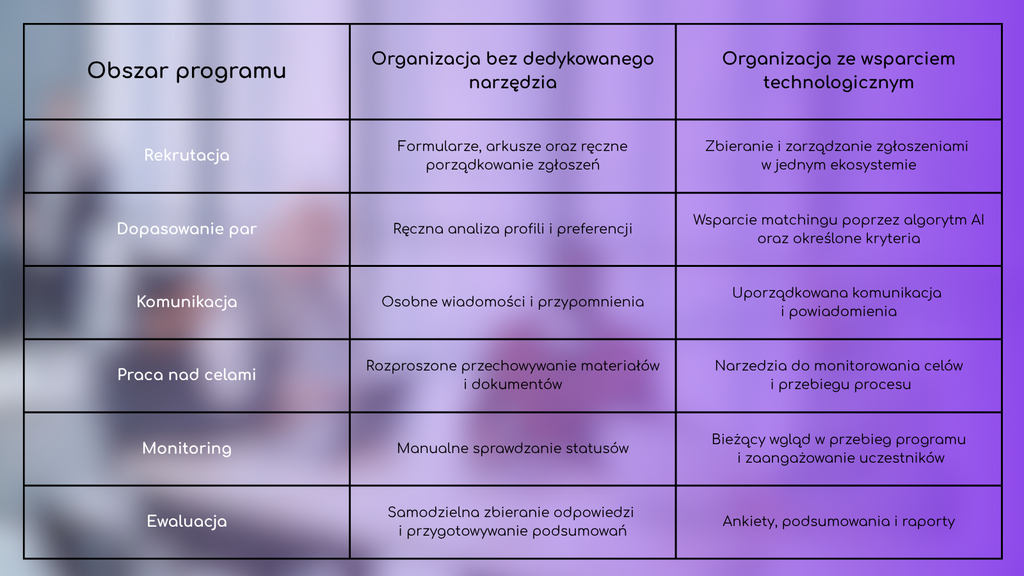
This does not mean that the platform takes responsibility for the quality of mentoring. Clearly defined goals, participant preparation, effective pair matching and support from the program organizer remain essential. Technology helps ensure the process is consistent, reduce repetitive tasks and make better use of the information collected during the program.
How does Mentiway support employee development in organizations?
Mentiway is an HRTech solution focused on organizing and running mentoring programs in companies, foundations and universities. The platform supports program organizers at every stage: from program planning and recruitment, through matching mentors and mentees, to monitoring, collecting feedback and reporting.
In practice, this includes the ability to:
- match pairs based on competencies, experience, development needs and additional criteria set by the organization;
- manage participants and the program in one place;
- support work on development goals and mentoring meetings;
- use materials and tools that support mentors and mentees;
- monitor activity and collect the information needed to evaluate the program.
The solution is used in programs of various sizes and types. Over the past 12 months, more than 6,000 users have used the platform, nearly 15,000 sessions have been recorded on it, and Mentiway has supported more than 60 mentoring programs.
These figures show the scale of platform use and user activity. They should not be equated directly with the number of completed programs or business goals achieved. However, they provide a tangible picture of the processes organizations can run using a dedicated tool.
It is also worth looking at the participants’ own experiences. In Mentiway’s “The Mentoring Experience in Organizations” survey, we collected 613 responses from 43 mentoring programs run on the platform. 96.53% of respondents rated mentoring positively as a development method, and the NPS for mentoring as a method of personal development was 79.More than 96% of respondents would like mentoring to be implemented more widely in their organization.
These results show how participants rate mentoring and what their experiences with it are. However, they are not a measure of the return on investment in the platform or proof that mentoring directly affects companies’ financial performance. We presented the full results, methodology and conclusions in the Mentiway 2026 report, “The Mentoring Experience in Organizations”.
How to choose an HRTech solution for a medium-sized or large company?
Choosing HR technology should start with defining the need the organization wants to address. Only then is it worth comparing the available solutions and their features. A system may offer a long list of capabilities, but not every feature will be genuinely useful in a particular organizational environment.
There are several factors worth considering before implementation.
Fit with the organization’s processes and goals. The tool should support a specific HR process, rather than force changes to the way people work just to make use of its features. It is worth checking whether it can be adapted to the company’s specific context and the needs of different user groups.
Scalability. The solution should work not only for a small pilot, but also as the number of users or programs grows. In large organizations, the ability to manage different groups, structures and process iterations is important.
Data security. HR systems process employee information, so access, storage and data processing policies are important, as are compliance with applicable regulations and transparency around the provider’s responsibilities.
Reporting and access to information. It is worth checking what data can be collected, how it is presented and whether it can be used to assess how the process is progressing. Reports should help inform decisions, rather than simply list the number of activities.
Integration with existing tools. A new solution should fit the company’s technology environment. It is worth finding out whether integration with the systems already in use is possible, and to what extent.
User experience. Even a feature-rich platform will not serve its purpose if it is too complicated to use. The perspectives of both those managing the process and the employees who will use the tool every day matter.
Implementation support. Simply having access to a system does not guarantee that the organization will use it effectively. It is worth checking how administrators and users are onboarded, what materials are available and what support is provided after the solution goes live.
A good approach is to start with a clearly defined process and test the solution on a controlled scale. A pilot makes it possible to assess not only the system’s functionality, but also whether the tool genuinely makes work easier and meets the organization’s needs.
Technology supports HR, but people and strategy set its direction
HRTech solutions are changing how organizations plan, carry out and evaluate employee-related activities. They help reduce manual work, organize information, scale processes and make better use of data. In medium-sized and large companies, this can be particularly important, as even a well-designed initiative becomes difficult to manage when it involves many teams and hundreds of participants.
However, this does not mean that technology alone can solve the challenges involved in employee development. Clear goals, an understanding of the organization’s needs, manager engagement and a well-planned process are all essential. A system can help deliver that process, but it cannot replace the decision about the direction in which the company wants to develop its people.
At Mentiway, we believe technology should support relationships and development, not replace them. That’s why we’re developing a solution that helps organizations run mentoring programs at scale, while keeping what matters most in mentoring at the heart of it: people, their experience and their development goals.
Would you like to see how a mentoring platform can support development initiatives in your organization? Discover Mentiway and talk to us about your company’s needs.
FAQ: HRTech and technology in HR
What does HRTech mean?
HRTech (Human Resources Technology) refers to technologies and systems that support human resource management. It includes, among other things, recruitment tools, HR systems, learning platforms, talent management solutions, HR analytics and mentoring platforms.
What benefits does HRTech offer large companies?
HRTech can streamline HR processes, reduce manual administrative work, organize data, support communication and make it easier to coordinate initiatives involving large numbers of employees. It can also help track processes and prepare information needed to assess their effectiveness.
Does HRTech help measure the effectiveness of HR initiatives?
Yes. Many HRTech solutions make it possible to collect data on process delivery, user activity, participant experiences and progress. However, to assess business outcomes, this information needs to be linked to specific organizational goals and relevant metrics.
Is a mentoring platform an HRTech solution?
Yes. Mentoring platforms belong to the HRTech category because they support the organization and management of development processes. They can help with, among other things, recruiting participants, matching pairs, monitoring collaboration, working towards goals, and reporting.
What should you consider when choosing an HRTech system?
It is worth considering how well the system meets the company’s needs, its scalability, data security, reporting capabilities, integrations with other systems, user-friendliness, and the vendor’s implementation support. Above all, however, the tool should address a specific organizational challenge.

Hi, my name is Thomas. I am the Co-Founder of Mentiway. We are happy to share our knowledge and support organisations on their way to success! 💪 If you are interested in how to efficiently and effectively implement a mentoring programme in your organisation using technology:
 email me
 contact me on LinkedIn