



 Mentoring Tools - Home Page

Beliefs - Recognizing your automatic thoughts in mentoring
Beliefs - recognizing automatic thoughts in oneself
In the theoretical part on beliefs, we included a link to the Cebulograf by A. Popiel and E. Pragłowska.
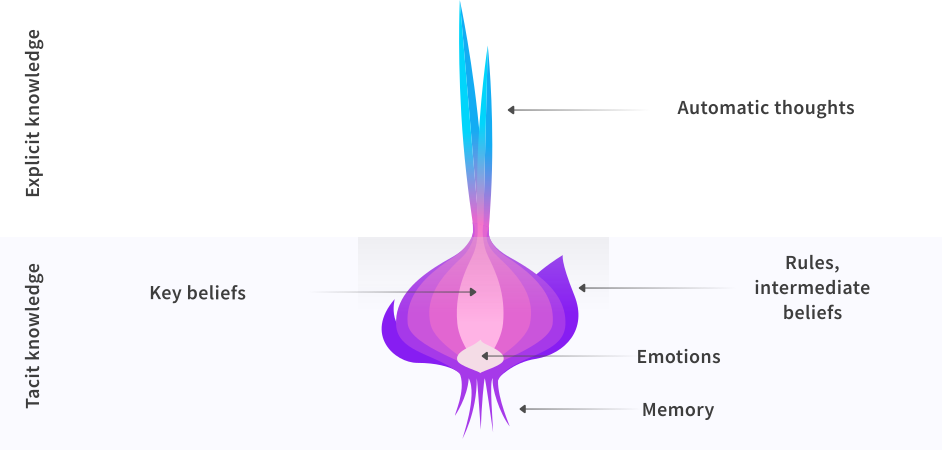
Key beliefs
These are basic beliefs about oneself and others.
Examples:
- I am weak.
- Women should not cry in front of men.
- People are naturally good.
Intermediate beliefs
They take the form of conditional statements and can also appear as life attitudes that we present.
Examples:
- If I get a promotion, I will achieve fulfillment.
- If I am nice, people will like me.
Automatic thoughts
They appear in a given situation regardless of our will. They are responsible for arousing emotions and appear immediately after a given stimulus.
Examples:
- I can't do it!
- It's all over.
- This is all pointless.
With automatic thoughts, emotions are often more pronounced than the content itself. That is why we encourage you to pay attention to your thoughts, feelings, and reactions from the body. All of this is valuable information for us.
To this end, you can write down your automatic thoughts. The table below will help you.
|
Situation - What happened? |
Thoughts - Interpretation of the situation - what did I think to myself? |
Emotions - What do I feel in connection with this? |
Reactions - How did my body react? |
Behaviors - What did I do? |
|
|
|
|
|
Automatic thoughts, which are evidence of the existence of beliefs (short form, often unconditional, equivalent sentences):
- ...
- ...
- ...
- ...
- ...
Additional questions:
- What did I think then?
- Did I remember anything, and what?
- What does this situation mean to me?
- What does this situation say about me?
- What evidence speaks in favor of the truth of the thought?
- What evidence speaks against the reality of the thought?
- Is there an alternative explanation?
- What is the result of my belief in the reality of automatic thought?
- What could be the effect of changing my thinking?
- What can I do about it?
- What would I say to a friend if they were in this situation?
Recognizing automatic thoughts and beliefs is crucial because these irrational ones usually constitute significant limitations and do not serve us well.
Below you will find some examples of irrational beliefs and how they can be transformed.
|
IRRATIONAL BELIEFS |
RACJONALNE ODPOWIEDNIKI |
|
Everyone has to rely on someone stronger. |
Relying on others may make us dependent on them. We can seek help from others as long as we trust ourselves and our judgment. |
|
I should feel sorry when other people have problems, and I should be sad when others are sad. |
I cannot solve other people's problems or improve their well-being by feeling sad about them. |
|
Every problem has a perfect solution, and I must find it. |
Problems can usually be solved in several ways. Thinking about the perfect solution is good, but problems are solved by choosing the best action. I do not have to solve everything perfectly. |
|
To be a valuable person, I must be competent, and I must succeed at everything I do. I am not allowed to make mistakes. |
I always try to achieve as much as possible, but everyone makes mistakes. It is better to accept myself as a person regardless of how much I have achieved because there will always be someone who does it better than me. |
Source: Wikipedia.pl: Albert Ellis: Deep Healing of Emotions. Krakow: Zielona Sowa, 2008. ISBN 978-83-7435-770-8. Bennett-Levy, J, et al. (eds.) Oxford Handbook of Behavioural Experiments in Cognitive Therapy. Gdynia: Alliance Press (2005).
Mentoring Tools - Home Page